Showing posts with label Pierre Jules Theophile Gautier. Show all posts

Thursday, 16 June 2022

A Nineteenth-Century Ballet Reimagined: Akram Khan’s Giselle, Brooklyn Academy of Music

I’ve written about ballet through a Victorianist’s lens quite a few times over the course of the last nine years on this blog, but, thanks partly to the pandemic, it’s been a while since I was able to review a live performance. I blogged about Coppelia and Anna Karenina in 2018, Le Corsair and The (ever-popular) Nutcracker in 2016, and Jane Eyre back in 2013. This time I’m back to talk about one of the greatest nineteenth-century ballets—Giselle—having just seen a very different production.

Giselle, with music by Adolphe Adam and a story by librettists Theophile Gautier and Jules-Henri Vernoy de Saint-Georges, was first performed in 1841 in Paris, starring ballerina Carlotta Grisi in the title role. The ballet is in two acts—the first tells the story of the peasant girl Giselle’s betrayal by her lover, Albrecht (a nobleman in disguise), and her subsequent death; the second reanimates Giselle as she joins a host of wilis (spirits seeking revenge against the men who wronged them). 

I’ve seen traditional Giselles several times (most recently, the ABT’s production was my first live theater experience post-Covid lockdowns in October 2021). But last week I was lucky enough to watch Akram Khan’s innovative version by the English National Ballet. This production premiered in the UK in 2016, but the short run at BAM (the Brooklyn Academy of Music) marked its first performance in New York City. I saw the Saturday matinee, with Erina Takahashi as the lead. 

Gone is the pastoral setting of the traditional first act, with Giselle and her peasant girl friends skipping outside cottages and responding to the hunter’s bugle call. The production instead invites us into a stark and industrial setting. The nobles here are the “landlords” and the peasants “outcasts” who work in the condemned factory. Dressed in gray rags, Giselle and her community flit around stage, their movements often synchronized, to percussive music from Vincenzo Lamagna.

Ballet fans will recognize strains of the original score coming in and the basics of the storyline remain the same, but the contrast between two acts is dampened—this is a Giselle that’s dark throughout. I enjoyed this tonal shift from the original: Act II of the ballet is often considered stronger and was often performed alone even in the 1800s. But audiences may find themselves asking if Giselle’s death is so terrible given the miserable, dystopian existence she experienced before. 

I was pleased however that the bleakness is heightened by genuine spookiness in Act II, thanks in part to a wonderful performance by Isabelle Brouwers as Myrtha, the queen of the wilis. The production uses pointe work (largely absent from Act I) to convey the ghosts’ ethereal movements to great effect. So far, so traditional, but these spirits also brandish large sticks as weapons, bringing martial arts style choreography to the all-female corps de ballet on their tiptoes. This sticks are also used to act as physical barriers between the living and the dead, leading to an ending I found genuinely emotional, as Giselle forgives Albrecht and returns, divided from him, to her grave.

There are plenty of clips of the production online, but, if you can, do try to see this ballet live—it’s a theatrical experience I’ll be thinking about for a long time.

Do you know of any upcoming NYC shows you’d love the Secret Victorianist to review? Let me know—here, on Facebook, via Instagram, or by tweeting @SVictorianist.

Friday, 14 January 2022

2021: My Year in Reading—A Retrospect

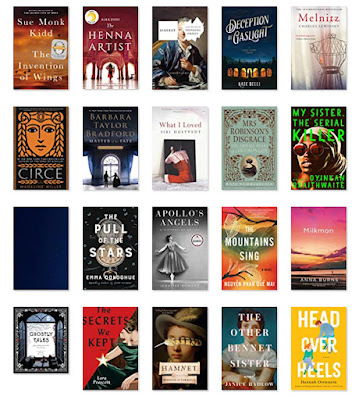
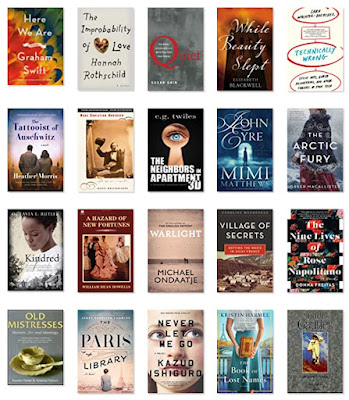
Around this time a year ago, I published a retrospect on my 2020 reading. Now I’m back, a year on, with a similar post, looking back on the 60 books (10 more than the year before!) I read in 2021. 

In 2021, I read 45 novels and 15 works of non-fiction. I favored books by women writers, reading 49 books penned by women, 10 by men, and one mixed anthology. Ten of the books I read were by writers of color. And, unsurprisingly for a writer of historical fiction, “hist fic” remained my favorite genre, making up nearly half (26 books) of what I read this year.

Favorites

Just like last year, I’m chickening out and not crowning a favorite read of the year, but in no particular (okay alphabetical) order, here are my top five fiction recommendations:

Milkman, Anna Burns (2018)

An original, lyrical, Booker Prize-winning novel set in Northern Ireland (where I grew up)? Of course, I was going to love this book! Be warned: Milkman isn’t an easy read, but it’s a rewarding one.

The Pull of the Stars, Emma Donoghue (2020)

We’re living through one pandemic, so do we really want to read about another? The answer is yes, but only if that book is Emma Donoghue’s story of the Spanish Flu, set in Dublin in 1918. A gritty insight into a nurse battling on a maternity ward as Europe is ravaged by war and disease, coupled with a queer love story, this novel is a winner for historical fiction fans. 

Never Let Me Go, Kazuo Ishiguro (2005)

I also read Ishiguro’s newest release, Klara and the Sun (2021), this year. I enjoyed it too, but his 2005 novel of an English boarding school that isn’t quite what it seems wins my vote.

Hamnet, Maggie O’Farrell (2020)

Everyone was raving about this novel about Shakespeare’s wife in 2020. I didn’t get to it until 2021, but believe the hype—this is one beautiful book!

The Little Stranger, Sarah Waters (2009)

I love a Gothic ghost story with a stylish historical background and a great twist. Above all, Sarah Waters is a great storyteller—expect to fly through this one. 

Feeling Arty?

One theme I noticed in my reading in 2021, was that I was very drawn to books that deal with other art forms beyond the literary. Here are some recommendations if you’re into…

Visual Arts:

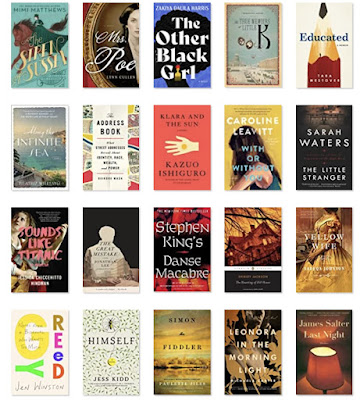
Novels—Leonora in the Morning Light, Michaela Carter (2021); What I Loved, Siri Hustvedt (2002); The Improbability of Love, Hannah Rothschild (2015)

Non-Fiction—Old Mistresses, Rozsika Parker & Griselda Pollock (1982)

Dance:

Novel—The True Memoirs of Little K, Adrienne Sharp (2010)

Non-Fiction—Apollo’s Angels, Jennifer Homans (2010)

Music:

Novels— Simon the Fiddler, Paulette Jiles (2020) (review here); Along the Infinite Sea, Beatriz Williams (2015)

Memoir—Sounds Like Titanic, Jessica Chiccehitto Hindman (2020)

Or Want to Feel Scared?

Another theme was books that deal with the strange, the spooky, and the downright frightening. In addition to The Little Stranger, which I wrote about above, I also read Shirley Jackson’s classic The Haunting of Hill House (1959), Mimi Matthews's gender-swapped retelling of Charlotte Bronte's Jane Eyre with a vampiric twist, John Eyre (2021) (review here), and Ghostly Tales: Spine-Chilling Stories of the Victorian Age (2017), an anthology of nineteenth-century ghost stories. 

For a survey of the horror genre, also check out Stephen King’s non-fiction book, Danse Macabre (1981). As someone who loves both The Sound of Music and horror movies, I couldn’t get behind everything King writes here, but his overview is well worth reading.

Discover Fascinating Lives

Finally, the biographies I read in 2021 are reflective of my interest in lesser spoken about historical figures, who I think led lives worth remembering. 

Join me by taking an interest in…

Denis Diderot, French philosopher, art critic and writer (1713-1784): I read Diderot and the Art of Thinking Freely, Andrew S. Curran (2019).

Danish father of fairytales, Hans Christian Andersen (1805-1875): I read Hans Christian Andersen: The Life of a Storyteller, Jackie Wullschlager (2001).

French poet Theophile Gautier (1811-1872): I read Joanna Richardson’s 1959 biography, Theophile Gautier—Hist Life and Times.

His daughter, Judith Gautier (1845-1917), a poet, writer, and lover of Chinese culture: I read Joanna Richardson’s 1987 biography, Judith Gautier.

I’ll be back at the end of this year or the start of next with a summary of what I read in 2022. In the meantime, let me know if you have any reading recommendations for me. I’d love to know what books are on your nightstand. If you’re looking for a book to read, check out my debut novel, Bronte’s Mistress (2020). And, remember, you can always contact me, here, on Facebook, on Instagram, or by tweeting @SVictorianist. Happy reading! 
Sunday, 29 June 2014

A Victorian Alphabet: S is for Swinburne, Sappho and Sadomasochism


Matthew Arnold criticised Algernon Charles Swinburne for his ‘fatal habit of using one hundred words when one would suffice’. So it is perhaps strange that Swinburne, a poet notable for his diffusiveness, should be so heavily indebted to that most fragmentary of poets, known for her enigmatic brevity – Sappho.

Sappho’s slight oeuvre is of course the result 2,600 years of imperfect transmission but the broken nature of her poetry has become one of the most identifiable reasons of its appeal. Swinburne loved and admired Sappho from his schooldays at Eton, but feminist critics have criticised nineteenth-century male poets such as Swinburne and Pierre Jules Théophile Gautier for exploiting the gaps in Sappho, inserting themselves in the silence and populating the elisions with expressions of their own sexual and poetic desires.

Swinburne certainly found Sappho spoke to him in very personal ways, encompassing, but also going beyond, questions of sexual preferences – the appeal of sadomasochism, the experience and expression of what we might label ‘bisexual’ love. Sappho is perhaps most directly prominent in Swinburne’s ‘Anactoria’ (published as part of Poems and Ballands in 1866).

In the Days of Sappho, John William Godward
Anactoria is a female lover of Sappho’s, mentioned by name in Fragment 16, but it is Fragment 31, traditionally referred to as the ‘Ode to Anactoria’ despite the lack of addressee, which informs Swinburne’s poem more directly. In Sappho’s poem it is the physical effects of love and particularly sexual jealousy on the poet herself which is the focus:

For whenever I glance at you, it seems that I can say nothing at all but my tongue is broken in silence, and that instant a light fire rushes beneath my skin. I can no longer see anything in my eyes and my ears are thundering, and cold sweat pours down me, and shuddering grasps me all over, and I am greener than grass, and I seem to myself to be little short of death.

And Swinburne’s poem, written in a voice which is later confirmed to be Sappho’s, starts in the same vein:

My life is bitter with thy love, thine eyes

Blind me, thy tresses burn me, thy sharp sighs

Divide my flesh and spirit with soft sound,

And my blood strengthens, and my veins abound.

But in Swinburne’s poem, the violence soon shifts to be directed towards Anactoria, not just caused by her: 

I would my love could kill thee; I am satiated

With seeing thee live, and fain would have thee dead.

….

I would find grievous ways to have thee slain,

Intense device, and superflux of pain;
Vex thee with amorous agonies, and shake
Life at thy lips, and leave it there to ache

This violence isn’t only the result of jealousy – rather, it is a source of pleasure in itself and the natural result of a love which is imagined as being equally painful to both parties:

I feel thy blood against thy blood: my pain
Pains thee, and lips bruise lips, and vein stings vein.

For both Swinburne and Sappho, sex and pain are inexorably linked and in both poems the natural result of love is death, but Sappho’s importance to the later poet isn’t only a question of a shared interest in sadomasochism. In a 1914 article in The Saturday Review on Sappho, Swinburne wrote:

Judging even from the mutilated fragments fallen even within our reach from the broken altar of her sacrifice of a song, I for one have always agreed with all Grecian tradition in thinking Sappho to be beyond all question and comparison the very greatest poet that ever lived.

In ‘Anactoria’ the equal pain which Swinburne imagines, is not mirrored in an equal death – Sappho will survive, while her lovers will not, because of the uniqueness of her song:

Yea, they shall say, earth’s womb has borne in vain

New things, and never this best thing again;

Borne days and men, borne fruits and wars and wine,

Seasons and songs, but no song more like mine [emphasis mine]

In his 1914 article, Swinburne continues:

Aeschylus is the greatest poet who ever was also a prophet; Shakespeare is the greatest dramatist who ever was also a poet; but Sappho is simply nothing less – as she is certainly nothing more – than the greatest poet who ever was at all.

It is this ‘faith’ of Swinburne’s in the perfection of Sappho’s poetry, rather than her sexual subjects, which cements her worth.

What should be T in my Victorian Alphabet? Let me know here, on Facebook or by tweeting @SVictorianist.