
As 2023 comes to a close, it’s time to review what I read in the last year. How did my habits change compared to 2022 and what themes emerged from the books that made it from my TBR and onto my nightstand? As usual, I tracked my progress via Goodreads and set myself a challenge on the platform, so to keep up with what I’m reading in 2024, make sure you connect with me there.
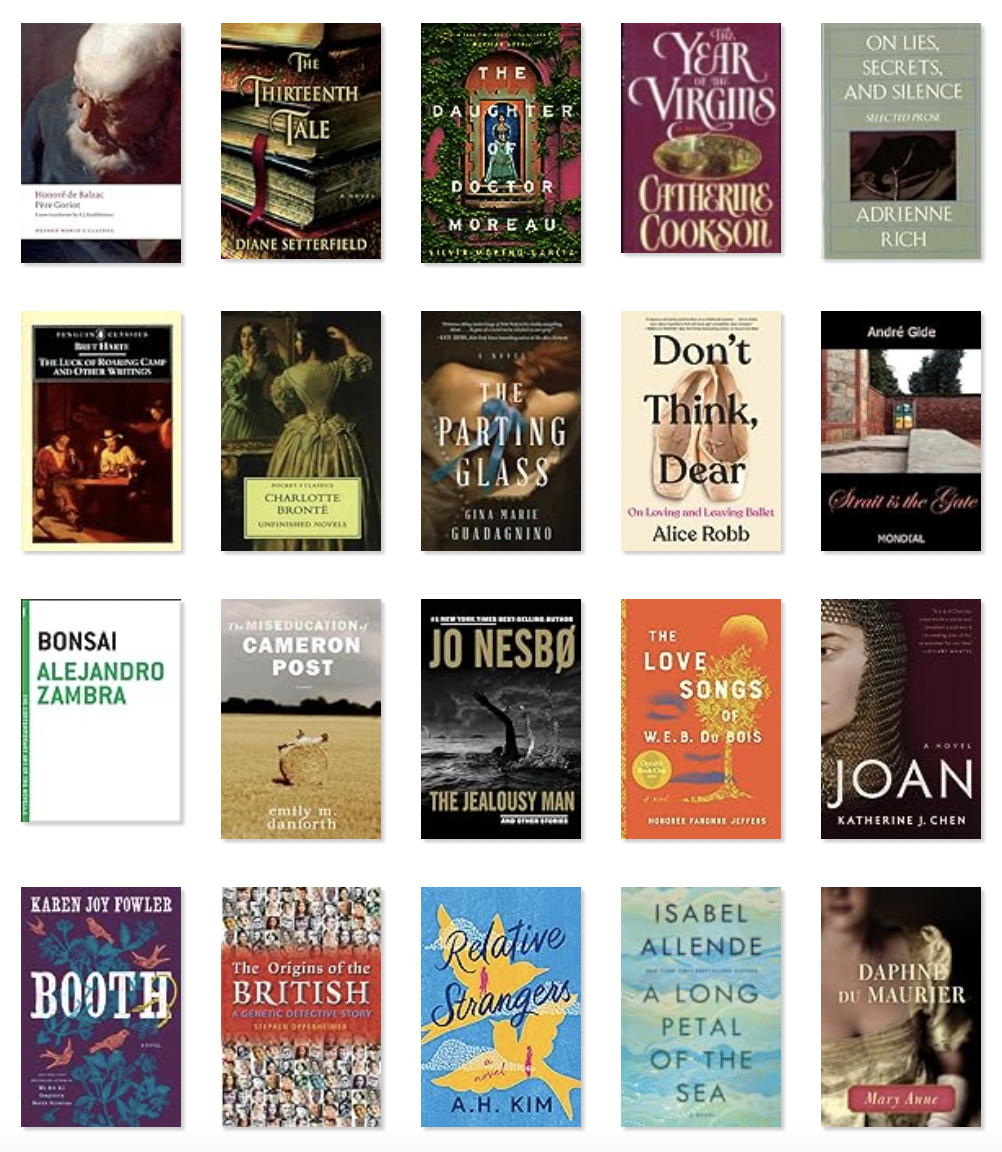
In 2023, I read 50 books (compared to 60 in both 2021 and 2022). At this slower pace, I had to average ~50 pages a day, which was still at times a tough ask, but achievable during what has been a hectic year.
I leaned towards selecting books by female writers—38 of the books I read this year were by women and 12 were by men.
Novels made up the bulk of my reading material—they accounted for 36 out of 50 reads. But I also read 10 works of non-fiction, three plays/collections of plays, and one collection of short stories.

As you might expect from a writer of historical fiction, the genre remains my favorite—19 of the books I read in 2023 fit into this category. But I also read 5 novels with strong fantasy/speculative elements and 4 that dealt with mystery and/or crime.
Nine of the authors I read this year are known to me personally. Congratulations again to Hope C. Tarr, Nancy Bilyeau, and Nicole Evelina for the publication of their 2023 novels and to Richard Huddleson for his dramatic translation.
I reviewed five of the novels I read on this blog, so check out the full posts for my take on each of them. They were Karen Joy Fowler’s Booth (2022), Gina Marie Guadagnino’s The Parting Glass (2019), Silvia Moreno-Garcia’s The Daughter of Doctor Moreau (2022), Julie Gerstenblatt’s Daughters of Nantucket (2023), and Rachel Cantor’s Half-Life of a Stolen Sister (2023).
The top theme that emerged from my reading this year was romantic and/or intense relationships between women characters. Yiyun Li's The Book of Goose (2022), Julia Fine's Maddalena and the Dark (2023), Gina Marie Guadagnino's The Parting Glass (2019), and Emily M. Danforth's The Miseducation of Cameron Post (2012) all fit into this category.
I also read two Bronte-related books (Lucasta Miller’s The Bronte Myth (2001) and Rachel Cantor’s Half-Life of a Stolen Sister (2023)), and two ballet-related books (Adrienne Sharp’s White Swan, Black Swan: Stories (2002) and Alice Robb’s Don’t Think, Dear: One Loving and Leaving Ballet (2023)).
One thing I enjoyed this year was mixing up my reading by turning to books I wouldn’t necessarily have chosen by myself but ended up loving. A book club led to me reading Michelle Zauner’s Crying in H Mart (2021), while Ursula Parrott’s Ex-Wife (1929) was a gift that became one of my favorite reads of the year.

Going into 2024, I hope to continue to bring this same spirit of experimentation to my reading. I’m looking forward to seeing which 50 books I turn to next…
What were your top reads of 2023? Let me know—here, on Instagram, on Facebook, or by tweeting @SVictorianist. Want to keep up with my reading and writing? Sign up for my email newsletter here.

