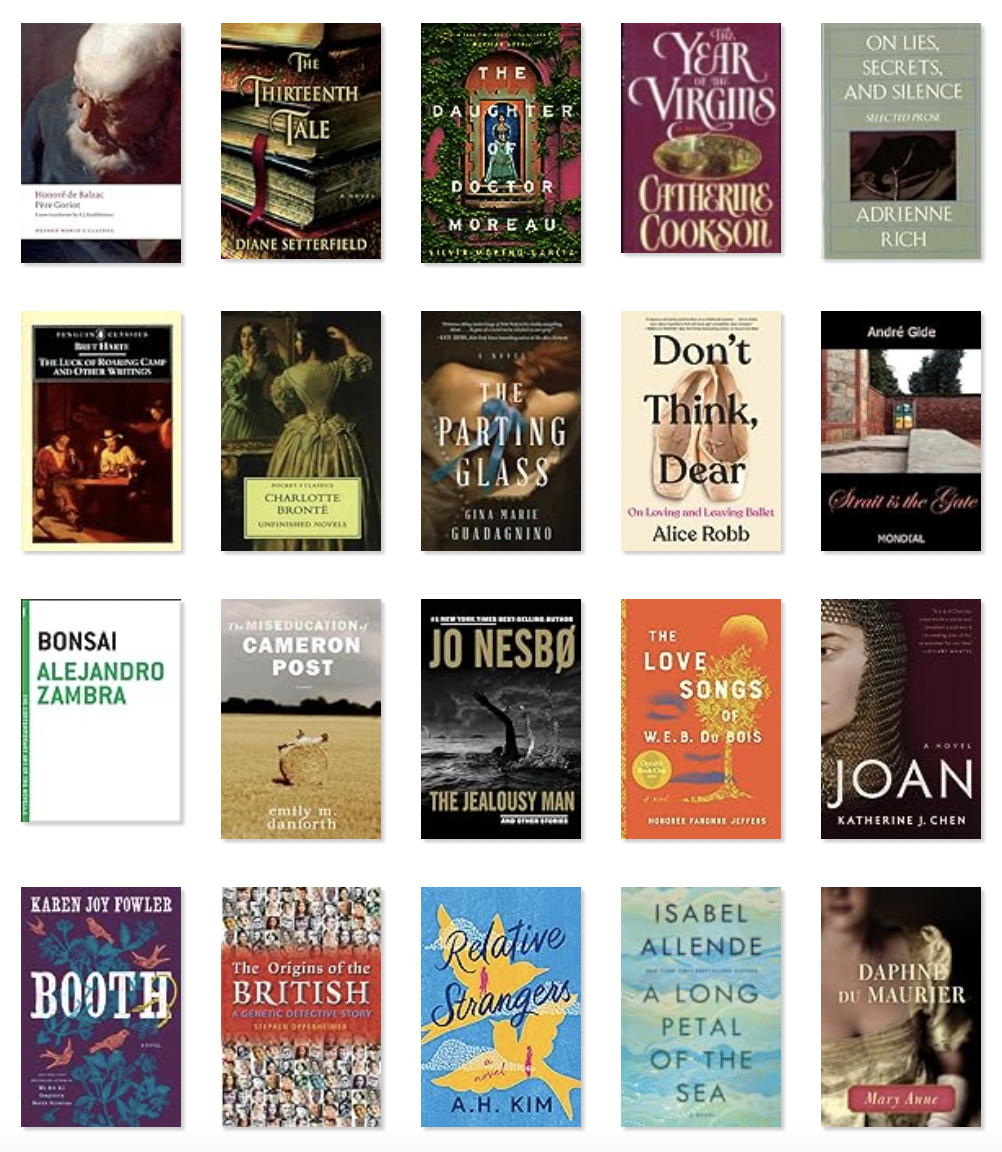
As 2023 comes to a close, it’s time to review what I read in the last year. How did my habits change compared to 2022 and what themes emerged from the books that made it from my TBR and onto my nightstand? As usual, I tracked my progress via Goodreads and set myself a challenge on the platform, so to keep up with what I’m reading in 2024, make sure you connect with me there.
In 2023, I read 50 books (compared to 60 in both 2021 and 2022). At this slower pace, I had to average ~50 pages a day, which was still at times a tough ask, but achievable during what has been a hectic year.
I leaned towards selecting books by female writers—38 of the books I read this year were by women and 12 were by men.
Novels made up the bulk of my reading material—they accounted for 36 out of 50 reads. But I also read 10 works of non-fiction, three plays/collections of plays, and one collection of short stories.
As you might expect from a writer of historical fiction, the genre remains my favorite—19 of the books I read in 2023 fit into this category. But I also read 5 novels with strong fantasy/speculative elements and 4 that dealt with mystery and/or crime.
Nine of the authors I read this year are known to me personally. Congratulations again to Hope C. Tarr, Nancy Bilyeau, and Nicole Evelina for the publication of their 2023 novels and to Richard Huddleson for his dramatic translation.
The top theme that emerged from my reading this year was romantic and/or intense relationships between women characters. Yiyun Li's The Book of Goose (2022), Julia Fine's Maddalena and the Dark (2023), Gina Marie Guadagnino's The Parting Glass (2019), and Emily M. Danforth's The Miseducation of Cameron Post (2012) all fit into this category.
I also read two Bronte-related books (Lucasta Miller’s The Bronte Myth (2001) and Rachel Cantor’s Half-Life of a Stolen Sister (2023)), and two ballet-related books (Adrienne Sharp’s White Swan, Black Swan: Stories (2002) and Alice Robb’s Don’t Think, Dear: One Loving and Leaving Ballet (2023)).
One thing I enjoyed this year was mixing up my reading by turning to books I wouldn’t necessarily have chosen by myself but ended up loving. A book club led to me reading Michelle Zauner’s Crying in H Mart (2021), while Ursula Parrott’s Ex-Wife (1929) was a gift that became one of my favorite reads of the year.
Going into 2024, I hope to continue to bring this same spirit of experimentation to my reading. I’m looking forward to seeing which 50 books I turn to next…
What were your top reads of 2023? Let me know—here, on Instagram, on Facebook, or by tweeting @SVictorianist. Want to keep up with my reading and writing? Sign up for my email newsletter here.
Merry Christmas/Happy Holidays to everyone celebrating this festive season and welcome (back?) to the Secret Victorianist—my blog dedicated to nineteenth-century literature and culture. In today’s post, I share some gift (or let’s face it, self-gifting) ideas for lovers of books and Victoriana. Let me know what you think and what else is top of your wish list…
For the busy bookworm… Consider giving them an annual subscription to Audible, so they can listen to books with their hands full or while on the go.
For the Victorianists who read the footnotes… The Longman Annotated Poets series is incredible. Why not pick up their Selected Edition of Tennyson’s poetry?
For historical fiction fans… Some of the best #HistFic books I read this year were Booth by Karen Joy Fowler, Joan by Katherine J. Chen, The Daughter of Dr. Moreau by Silvia Moreno-Garcia, A Witch in Time by Constance Sayers, and The Orchid Hour by Nancy Bilyeau.
For fans of the Victorian aesthetic… Buy them a locket or a cape or a fan or a corset or a parasol or a print of a Pre-Raphaelite painting or William Morris wallpaper.
For those looking to time travel… Consider booking an experience (e.g., getting tickets to a ball, visiting a stately home, or having afternoon tea).
For letter writers… Beautiful, monogrammed stationery makes for a wonderful gift. Wax seal = optional.
For Bronte fans… My fiction pick for the year is Rachel Cantor’s Half-Life of a Stolen Sister (check out my review here) or my own novel Bronte’s Mistress, of course, while I recommend Lucasta Miller’s The Bronte Myth to those who prefer non-fiction.
For historical novelists… Buy them a ticket to the Historical Novel Society Conference 2024, at Dartington Hall in the UK. We’re going to have a blast.
Have more ideas to add to my list? Share them below, on Facebook, on Instagram, or by tweeting @SVictorianist. Want a signed copy of Hope C. Tarr’s Irish Eyes (2023), another great historical fiction read? Sign up to my monthly email newsletter by December 7th for a chance to win!
Welcome back. Two weeks ago, I attended the Historical Novel Society North America conference in San Antonio, Texas, and shared some of my favorite quotes from the sessions I listened to live at the multi-day event. Today, as promised, I’m back with more words of wisdom from the speakers I caught later via the on-demand recordings. There was so much great content available that I still have a few sessions remaining, so expect a Part Three of this blog in the next few weeks…
On location in San Antonio, TX
AI & Technology:
“ChatGPT is a terrible writer. It’s boring. It will learn and become a better writer, but for now it’s not going to take your writing jobs,” Katie Aiken Ritter (writer)
“We’re not seeing any originality of expression from ChatGPT—things like word choice that writers are known for,” Sarah Johnson (librarian)
“ChatGPT is good at getting rid of ‘BS jobs’,” Jonathan Putnam (writer)
“As storytellers, we’re about to experience a renaissance. Our options for how we carry out our work as storytellers are expanding at a dizzying rate,” Libbie Grant (writer)
Fiction vs. Journalism:
“I wanted the freedom to make things up. Journalism didn’t give that to me. I can always tell when someone is writing fiction who was a journalist,” Weina Dai Randel (writer)
“I found that as a journalist I had to strip myself down and build myself up again. Non-fiction is much denser. Fiction is about character,” Nancy Bilyeau (writer)
“The transition from writing journalism to fiction is a nightmare,” John Jeter (writer)
Specific Periods:
“The Renaissance was the era of unexpected alliances,” Karimi Alavi (writer & educator)
“The big problem with seafaring books is that women didn’t have a significant legitimate role on commercial or naval vessels until the late 20th-century, except as passengers. Romantic heterosexual relationships do not flourish in this genre,” Mary Malloy (writer)
“WWII fiction remains popular as WWII was the last great war that was fought for noble reasons and high stakes,” Maryka Biaggio (writer)
Writing Craft:
“You don’t have much time to convince readers to come on a 400-page journey with you,” Susan Meissner (writer)
“The concept of a story world is very familiar in fantasy and science fiction writing, but historical fiction writers are creating worlds as well—it just happens to be a world based on something that happened in the past. If it’s not a world that exists now, we have to build it,” Mark Baker (writer)
Doing the Work:
“I encourage my students to see writing as a job, whether it’s full-time or part-time,” Joyce Wagner (writer)
“There’s no such thing as writer’s block. If you think there is, go get a job at a newspaper and go tell your editor you’re just not feeling inspired today to write,” Glen Craney (writer)
Characters:
“A character doesn’t have to be admirable—at the start at least—for us to want to follow them,” James Scott Bell (writer)
“As a writer and a researcher, I want to know more about the women who were at the center of history but are often ignored to the point of becoming non-existent,” DeAnn Smith Stead (writer
Research:
“Primary sources help you get, not just to the facts, but to the attitudes,” Addison Armstrong (writer)
“Avoid unforced food history errors in your writing,” Amanda E. Herbert (academic)
Copyright:
“Works are in the public domain if they predate copyright law, if the copyright term has expired, or if they are un-copyrightable. Works published in 1927 came into the public domain in 2023,” Emily Lanza (writer & lawyer)
Vocation:
“It’s not always a conscious choice to write fiction. We’re drawn to it,” Vanitha Sankaran (writer)
Are you also still listening to the great recordings from HNS 2023? I’d love to hear what your favorite sessions were. Let me know—below, by tweeting @SVictorianist, or by contacting me via Instagram or Facebook.
Love all things historical fiction? Sign up to my monthly newsletter here.
I’m currently on my way home from the Historical Novel Society North America’s first in-person conference since 2019, which was held in San Antonio. For several days, IRL and virtual attendees enjoyed an array of talks, panels, and masterclasses from authors, agents, and editors in the historical fiction world. Those of us in Texas also enjoyed socializing and signing books at the readers’ festival, which was open to the public.
In today’s post I’ll be sharing some of the most memorable quotes from the presenters I heard in action, organized by theme. Stay tuned for a Part Two post once I catch up on other recorded sessions virtually!
Reporting live (almost) from HNS 2023!
Writing Craft:
“Write like you’re in love. Edit like you’re in charge,” James Scott Bell (writer)
“There is nothing worse than a confused reader,” Denny S. Bryce (writer)
“Your point of view character should be determined by the climax of your book,” Kimberly Brock (writer)
“Prologues exist because readers are impatient,” Mitchell Waters (agent)
Publishing Industry:
“Stories aren’t complete until we share them,” Lisa Wingate (writer)
“Readers, not publishers, are the ones who determine which books deserve to be read,” Libbie Grant (writer)
“There are fewer and fewer people working on more and more books,” Marcy Posner (agent)
“Especially on kidlit, what I’m hearing is that editors want books about LGBT characters that aren’t about trauma but are about joy,” Shannon Hassan (agent)
Our Genre:
“History tells you what happened. Historical fiction tells you how it felt,” Jamie Ford (writer)
What to Write:
“American readers want to read about the topics most pertinent to them,” Weina Dai Randel (writer)
“I’m fascinated by the staff’s point of views, especially overlooked women,” Mariah Fredericks (writer)
Sex Scenes:
“Sex can reflect agency or loss of agency,” Laurie Lico Albanese (writer)
“Many book club readers skip the sex scenes. Proceed with caution,” Heather Webb (writer)
Retellings:
“We are always writing retellings. When we write new takes on classic tales the source is just more obvious,” Kris Waldherr (writer)
“For me, retellings are always about exploring different perspectives on a story,” Molly Greeley (writer)
Witches:
“Witches are a powerful symbol for marginalized people,” Paulette Kennedy (writer)
“We are righting a wrong and reclaiming the title of witch,” Alyssa Palombo (writer)
The Arts in Fiction:
“As writers we know what it feels like to create, so we can transpose these emotions onto other arts,” Carol Cram (writer)
Research:
“It helps me to walk the walk and take photos of places my characters would have been,” Nancy Bilyeau (writer)
Marketing:
“TikTok is a hot mess. No one knows what will go viral. What works on Instagram doesn’t necessarily work there but I post it on TikTok anyway for the content,” Vanessa Riley (writer)
If you were at HNS 2023 I’d love to hear what quotes and advice stood out to you from the conference—let me know below, by tweeting @SVictorianist, or by contacting me via Instagram or Facebook. Reading this later and on the fence about joining us for HNS 2025 in Las Vegas? I, for one, would love to see you there.
Love all things historical fiction? Sign up to my monthly newsletter here.
I attended my first Historical Novel Society North America Conference in Maryland back in 2019 and wrote a detailed review about my experience. In 2021, one published book and one global pandemic later, I attended my second—this time virtually.
My Zoom set up for the conference
On this occasion, I wasn’t a newbie, who’d just signed her first book deal, but a speaker, appearing on the “Shaking up the Brontes” panel with Michael Stewart, Syrie James, and Rowan Coleman. This time around, attendees jumped between Zoom calls and live streams, rather than racing between conference rooms. And we all posted and pinged, rather than chatting over glasses of wine. But still, one thing remained the same—we were brought together by a love of writing and reading historical fiction, and had access to a wealth of collective knowledge.
For this blog post then, I’m not going to review the conference (there’s little to say except “bravo!” to the beleaguered board and their band of trusty volunteers), or to write exhaustively about every session I attended (attendees have access to all recordings for 90 days so I still plan to listen to panels that I missed). Instead, I’m going to share a series of quotes that stood out and my thoughts on them.
“Disturb me if someone’s bleeding.”
A question that authors are often asked is how we have time to write, which is why I appreciated this quote from Sarah Woodbury. It’s what she tells her (don’t worry, older!) kids when she sits down at her keyboard. Woodbury shared her successful self-publishing journey, which requires her to be consistently productive.
“The thing that scares you most is what you’re meant to be writing next.”
Sadeqa Johnson received this advice from a friend and it’s stayed with her. At a conference of historical fiction obsessives, it was fascinating to hear the perspective of someone who turned to a historical subject (in The Yellow Wife) after first writing contemporary fiction. I liked her advice to make the braver choice when starting to work on your next idea.
“The great advantage of historical fiction is that there is already an established audience of people who are fans of your period.”
Publishing expert Jane Friedman gave this glimmer of marketing hope to the many historical fiction writers desperate to find readers for their books. She encouraged us to seek out the places where fans of our historical setting are already congregating online.
“Do characters have to be like your best friend? I think no.”
Nancy Bilyeau weighed in on character likability—something women characters are more often criticised for. One reason I love historical fiction is that it gives us the opportunity to enter the mind set of people from a different place and time with different values, so I’m in strong agreement with Bilyeau on this one.
“They may have murdered people, but we like them.”
Margaret George spoke about the merits of the morally ambiguous heroes we still love to root for (think Butch Cassidy, Robin Hood, or famous pirates). The majority of her examples in this vein were male historical figures, which interested me. Can our male main characters be killers, while female protagonists are expected to be best friend material?
My unimpressed conference buddy
“I don’t see it as my place to condemn.”
Lisa See has written about cultural traditions such as foot binding that might be difficult for modern audiences to understand, and she’s often asked by readers whether she wants us to come to specific conclusions on them. She sees her role as empathetic, rather than didactic, an approach that really resonated with me.
“I am happy to use real people for my own nefarious fictional ends.”
I’m surprised by how often I’m asked whether living descendants of Lydia Robinson have objected to my imagining of her life, so it was entertaining to hear Alex George talk unapologetically about borrowing from reality to make great fiction.
“It’s not a trend. It’s not a fad. It’s the way business should be run.”
This is what Denny S. Bryce had to say about the drive towards telling more diverse stories in historical fiction, and, in particular, the elevation of Black voices. Throughout the conference, she and many other writers and publishing professionals reiterated that inclusion isn’t just a conversation for 2021.
“Am I writing to explain this world to white people? I am not. I am not trying to translate.”
Leslye Penelope spoke about the intended audiences for her historical novels, and how for so long the assumed reader in this genre has been white. I loved the push to think beyond Black stories and characters to consider who we’re writing for and what cultural background we might be assuming.
“If a reader skips the sex scene they should miss part of the plot.”
Jennifer Hallock led a cozy chat on “good sex” in historical fiction. One takeaway? If your sex scenes are skippable, they aren’t doing their job. Good sex scenes aren’t just enjoyable in good fiction—they are vital to your story.
“What lies are people telling about themselves and what do those lies signify?”
I loved this question that Jeanne Mackin asks herself during the research phase. When she sees contradictions between what historical figures wrote about their own lives and other records, she asks herself what these lies and omissions could reveal about their characters.
“I hope that there’s an appetite from publishers and readers for novels about women who are totally unknown.”
One contradiction in the marketplace that was much discussed at the conference was publishing’s purported ambition to tell lesser-known stories from history, while it’s often marquee (i.e. recognisable) names that sell books. Marie Benedict expressed a desire I think many writers in the genre share—for the industry to elevate the stories of the truly unknown.
“You never hear a plumber say, ‘I just didn’t feel like plumbing today’.”
I’m not sure this statement’s entirely true (plumbers are allowed to complain too!), but I like the sentiment behind Erika Mailman’s words. Like her, I agree that writing is a job that takes perseverance, even when the going gets tough and the muse is silent.
Were you at the conference? If so, let me know what your favourite takeaways were—in the comments below, via Instagram or Facebook, or by tweeting @SVictorianist. My debut novel, Bronte’s Mistress, is now available in paperback, as well as hardcover, audiobook, and e-book. To stay in the loop about my books and blog posts, subscribe to my monthly email newsletter below.