Showing posts with label William Shakespeare. Show all posts

Saturday, 25 February 2023

Neo-Victorian Voices: Booth, Karen Joy Fowler (2022)

I imagine that many American readers will come to Karen Joy Fowler’s 2022 novel, Booth, with preconceptions about John Wilkes Booth (1838-1865), the man who assassinated President Abraham Lincoln (1809-1865). However, having grown up outside the US, my knowledge of the killer and the theatrical family he was part of was essentially nonexistent before I sat down to read this latest book in my Neo-Victorian Voices series, about novels set in the nineteenth century but penned in the twenty-first.
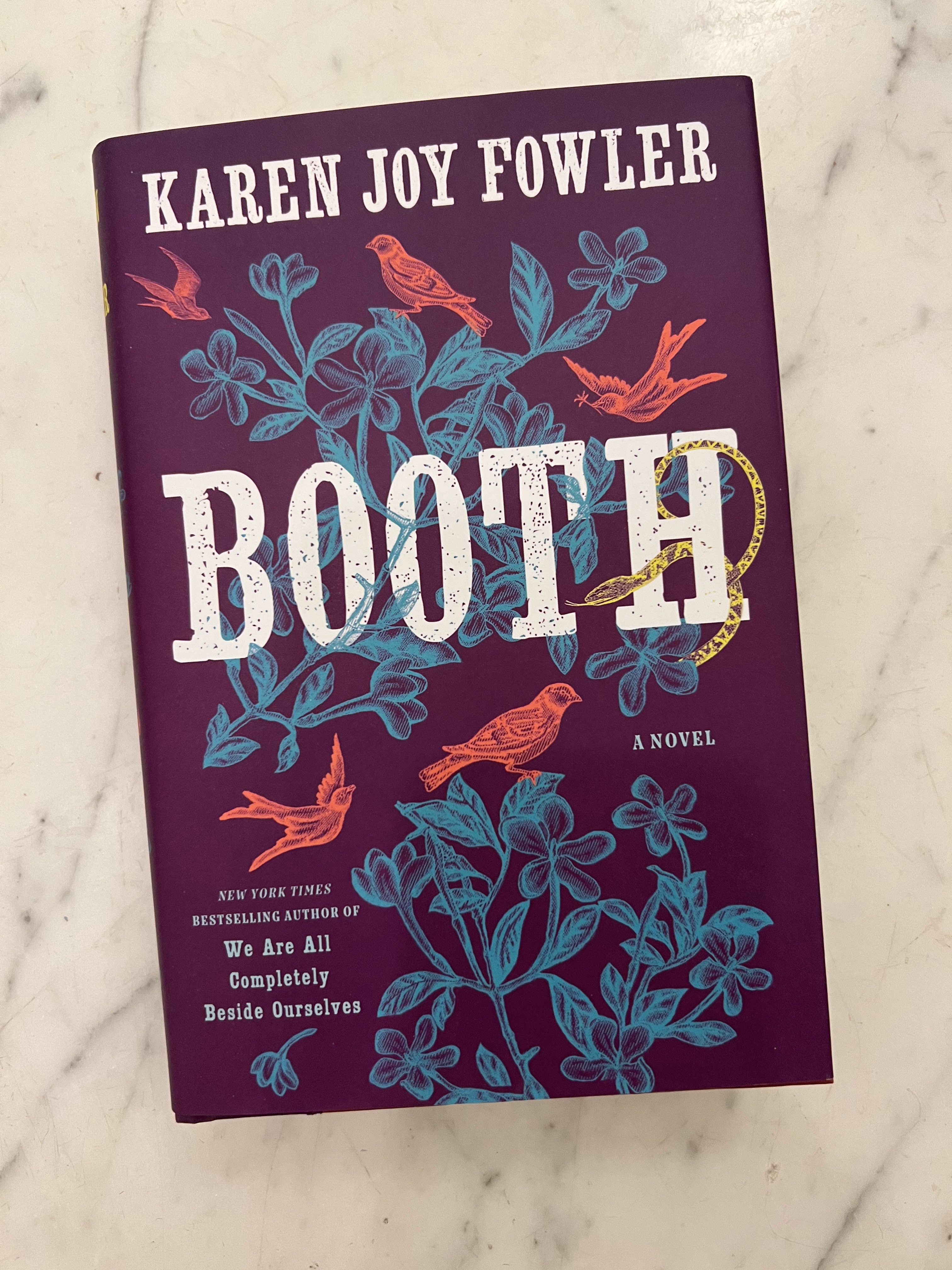

Booth is one of those novels where we know what the climax will be—Lincoln will die. Suspense comes instead from anticipating the emotional and practical responses of the rest of the Booth family to John’s actions. We move between three of his nine siblings’ points of view in the novel, jumping from the mind of invalid and put-upon Rosalie to famous actor Edwin to beautiful and fiery Asia. This isn’t a book about a murderer—it’s a book about how a murderer’s actions affect those who love him most, so I was unsurprised to read in Fowler’s author’s note that she was partially inspired to write the book by considering the position of modern mass shooters’ families. 

The real-life Booths are wonderful fodder for a novel. In addition to John’s assassination of Lincoln, parental bigamy, alcoholism, daring and dangerous journeys across the United States, theatrical productions galore, and a stock of other juicy rumors were all at Fowler’s disposal when she sat down to write this book. If she’d made all this up some reviewers would have called Fowler’s novel farfetched but all the craziest details about the Booths are true, meaning, especially later in the book, there is, at times, too much incident. I would have liked some breathing room to give the characters even more page space to react and reflect.

Lovers of Shakespeare will enjoy how much Fowler makes of the importance of the bard to the Booth family culture and may also be intrigued by the altered versions of his famous plays most performed during the nineteenth-century. I also liked learning about other popular plays from the time period, and the history of costuming (the fact that actors owned their own expensive costumes for different roles was fascinating!). 

Coming back to the preconceived ideas readers may have about the Booths, Fowler handles the topic of slavery very deftly. Without lecturing, the novel explores how and why the siblings ended up with opposing ideas about abolition, and the divisions created by birth order, age gaps, and very different childhood experiences in a large family rang particularly true. This is the story of the Booth siblings, but secondary characters, including the family’s Black servants who are trying to buy the freedom of their children still trapped in slavery, give us an even broader perspective on the macro-forces at work in the country during this era. 

What novel would you like to see my review next as part of my Neo-Victorian Voices series? Let me know here, on Facebook, on Instagram, or by tweeting @SVictorianist. Like what you read? Sign up to my email newsletter for monthly updates on my writing and blogging. 

Wednesday, 30 November 2022

Writers’ Questions: What IS Historical Fiction?

Hello and welcome back to my Writers’ Questions series, where I answer burning questions you might have about the craft and business of writing. As a writer of historical fiction, I’ve posted previously about some of my favorite and least favorite tropes in the genre, but I’ve never posted about what historical fiction actually is. Think the answer is straightforward? You might be mistaken…

At its simplest being an author of historical fiction means writing stories set in the past. But how far back would you consider “history”? As anyone knows who’s ever been to a thrift store and noticed clothes from a decade you remember being labeled as “vintage” knows, it can be very disorienting to see period you lived through being treated as historical. Yet, at the same time, World War II, one of the most common settings for historical novels being published in the early twenty-first century, is within living memory for some people alive today. 

Because of this, rather than choose an arbitrary number of years’ distance for a book to be labeled as #histfic, I favor Margaret Atwood’s definition: historical fiction is “set in a time before the writer came to consciousness.” That means that if I ever write a novel set in the 1970s, 1980s, or even the super early 1990s, I’d consider my setting historical. If another writer were a teen or adult during those decades and wrote a book drawing on memories as well as research, I wouldn’t consider it to be historical in the same way.

So much for the “historical” part of the name, but what about the word “fiction”? Believe it or not, this can be controversial too, as it’s very common to see real (and really famous!) historical figures showing up in the pages of historical novels. My answer here is much simpler: it doesn’t matter who your characters are; if your novel is set in the past and you’re making things up, it’s historical fiction. 

If your novel is primarily about a real person who lived in the past, you might like to use the label “biographical historical fiction”, and this is valid whether or not your protagonist is a household name like Napoleon or someone lesser known, like Lydia Robinson, the titular character of my debut novel, Bronte’s Mistress. Super recognizable historical figures are sometimes referred to as “marquee names” by those in the publishing industry as they are powerful marketing tools, but this term isn’t one that readers are usually familiar with. On the other hand, if a big historical figure just makes a cameo appearance in your book (e.g., you’re writing about London in the 1590s and William Shakespeare wanders into one of your scenes) that’s not enough for the sub-genre to be “biographical”.

Historical fiction is a wide genre bucket, so we see many crossovers with other genres too. Love stories that are set prior to the writer’s consciousness, which follow the romance novel structure, are designated “historical romance”. If your book is about a detective character solving a murder, many decades or centuries ago, congratulations, you’ve written a “historical mystery”. And if your historical setting has a magical twist, it sounds like you’re an author of “historical fantasy”.

Let me know what topic(s) you would like me to cover next in my Writers’ Question series! You can always contact me via the comments below, on Facebook, on Instagram, or by tweeting @SVictorianist.

Thursday, 29 November 2018

Art Review: It’s Alive! Frankenstein at 200, Morgan Library & Museum, New York City


In the summer of 1818, twenty-year-old Mary Shelley (then Mary Godwin, although living as ‘Mrs Shelley’ with Percy Bysshe Shelley in Geneva) wrote one of the most culturally influential stories in the English language. Her Frankenstein; or, The Modern Prometheus has spawned countless adaptations across multiple media and has come to be a definitive part of the Gothic and Romantic movements.

The Nightmare, Henry Fuseli (1781)
To mark the bicentenary of the novel’s creation, the Morgan Library & Museum has unveiled a major exhibition dedicated to the work and its influence.

Three Witches, Henry Fuseli (1783)
I began my visit by exploring the Gothic art that inspired Shelley and her contemporaries. Many of these paintings draw upon or suggest narratives, such as Henry Fuseli’s 1781 The Nightmare, in which a demon crouches atop a prostrate woman’s chest, and his 1783 Three Witches, which has influenced subsequent depictions of Shakespeare’s weird sisters. There are also skeletal depictions of Death, such as John Hamilton Mortimer’s drawing of Death on a Pale Horse (c.1775) and multiple instances of men and women attempting resurrections by an open grave.

Death on a Pale Horse, John Hamilton Mortimer (c.1775)
In the next section of the exhibition it’s easy to see synergies between the Gothic imagination and contemporary scientific advancements. Doctors and anatomists are depicted as grave robbers, while artists show their instruments destroying and restoring life, as well as extending it.

The Anatomist Overtaken by the Watch, William Austin (1773)
Parts of the Frankenstein manuscript are on display, as well as letters between the Godwins, Shelleys and others. The romance of the Frankenstein’s creation, and the characters of Shelley, Shelley, Byron and Keats, seem to add to its mystique and appeal, as much as the story itself.

The manuscript
In a second room we move out of the nineteenth century and into Frankenstein’s afterlife in film and graphic novels. We trace the monster’s evolution from reanimated corpse to superhuman villain to participant in superhero-style showdowns. The movies become weather vanes for the sensibilities of their time. For instance, the creature’s accidental child killing appalled audiences in 1931 and so the moment was cut from the film. The bride of Frankenstein (a creature Viktor chooses not to animate in Shelley’s original tale) becomes part of our cultural inheritance—here you can observe her wig, listen to her blood curdling screams.

A poster for the 1931 adaptation
At the centre of the exhibition is Richard Rothwell’s 1840 portrait of Mary Shelley. She watches over proceedings serenely as movie buffs, bibliophiles, and lovers of the macabre file through. I couldn’t help but wonder what she’d think of how Frankenstein and his monster have outlived her and evolved and how amazed she’d be that a tale born out of her time has come to represent so much about generations since.

Mary Shelley, Richard Rothwell (1840)
Which NYC exhibitions should the Secret Victorianist visit next? Let me know—here, on Facebook or by tweeting @SVictorianist.

Tuesday, 29 November 2016

Quiz: 19th-century...Shakespeare?


Do you have what it takes to marry your love of Victorian literature with your knowledge of English literature's most-famed writer?

Sunday, 29 June 2014

A Victorian Alphabet: S is for Swinburne, Sappho and Sadomasochism


Matthew Arnold criticised Algernon Charles Swinburne for his ‘fatal habit of using one hundred words when one would suffice’. So it is perhaps strange that Swinburne, a poet notable for his diffusiveness, should be so heavily indebted to that most fragmentary of poets, known for her enigmatic brevity – Sappho.

Sappho’s slight oeuvre is of course the result 2,600 years of imperfect transmission but the broken nature of her poetry has become one of the most identifiable reasons of its appeal. Swinburne loved and admired Sappho from his schooldays at Eton, but feminist critics have criticised nineteenth-century male poets such as Swinburne and Pierre Jules Théophile Gautier for exploiting the gaps in Sappho, inserting themselves in the silence and populating the elisions with expressions of their own sexual and poetic desires.

Swinburne certainly found Sappho spoke to him in very personal ways, encompassing, but also going beyond, questions of sexual preferences – the appeal of sadomasochism, the experience and expression of what we might label ‘bisexual’ love. Sappho is perhaps most directly prominent in Swinburne’s ‘Anactoria’ (published as part of Poems and Ballands in 1866).

In the Days of Sappho, John William Godward
Anactoria is a female lover of Sappho’s, mentioned by name in Fragment 16, but it is Fragment 31, traditionally referred to as the ‘Ode to Anactoria’ despite the lack of addressee, which informs Swinburne’s poem more directly. In Sappho’s poem it is the physical effects of love and particularly sexual jealousy on the poet herself which is the focus:

For whenever I glance at you, it seems that I can say nothing at all but my tongue is broken in silence, and that instant a light fire rushes beneath my skin. I can no longer see anything in my eyes and my ears are thundering, and cold sweat pours down me, and shuddering grasps me all over, and I am greener than grass, and I seem to myself to be little short of death.

And Swinburne’s poem, written in a voice which is later confirmed to be Sappho’s, starts in the same vein:

My life is bitter with thy love, thine eyes

Blind me, thy tresses burn me, thy sharp sighs

Divide my flesh and spirit with soft sound,

And my blood strengthens, and my veins abound.

But in Swinburne’s poem, the violence soon shifts to be directed towards Anactoria, not just caused by her: 

I would my love could kill thee; I am satiated

With seeing thee live, and fain would have thee dead.

….

I would find grievous ways to have thee slain,

Intense device, and superflux of pain;
Vex thee with amorous agonies, and shake
Life at thy lips, and leave it there to ache

This violence isn’t only the result of jealousy – rather, it is a source of pleasure in itself and the natural result of a love which is imagined as being equally painful to both parties:

I feel thy blood against thy blood: my pain
Pains thee, and lips bruise lips, and vein stings vein.

For both Swinburne and Sappho, sex and pain are inexorably linked and in both poems the natural result of love is death, but Sappho’s importance to the later poet isn’t only a question of a shared interest in sadomasochism. In a 1914 article in The Saturday Review on Sappho, Swinburne wrote:

Judging even from the mutilated fragments fallen even within our reach from the broken altar of her sacrifice of a song, I for one have always agreed with all Grecian tradition in thinking Sappho to be beyond all question and comparison the very greatest poet that ever lived.

In ‘Anactoria’ the equal pain which Swinburne imagines, is not mirrored in an equal death – Sappho will survive, while her lovers will not, because of the uniqueness of her song:

Yea, they shall say, earth’s womb has borne in vain

New things, and never this best thing again;

Borne days and men, borne fruits and wars and wine,

Seasons and songs, but no song more like mine [emphasis mine]

In his 1914 article, Swinburne continues:

Aeschylus is the greatest poet who ever was also a prophet; Shakespeare is the greatest dramatist who ever was also a poet; but Sappho is simply nothing less – as she is certainly nothing more – than the greatest poet who ever was at all.

It is this ‘faith’ of Swinburne’s in the perfection of Sappho’s poetry, rather than her sexual subjects, which cements her worth.

What should be T in my Victorian Alphabet? Let me know here, on Facebook or by tweeting @SVictorianist.

Tuesday, 1 October 2013

A Victorian Alphabet: C is for Caroline's Coriolanus

In a previous post, I looked at how emotional truths surpass the other benefits of classical learning for Charlotte Bronte heroines. But it’s not only in studying classical languages and literature that this preference for emotional education is expressed. In Shirley (1849), Shakespeare (particularly his Coriolanus) comes in for the same treatment, as Caroline Helstone, usually the pupil of French under the tutelage of Hortense, turns teacher of English for the evening, to the stern and initially emotionally unresponsive Robert. She introduces the ‘lesson’ like so:

‘Your heart is a lyre, Robert; but the lot of your life has not been a minstrel to sweep it, and it is often silent. Let glorious William come near and touch it. You will see how he will draw the English power and melody out of its chords.’

Caroline’s language is distinctly un-academic and the model of reading she subscribes to one based on emotional exchanges – between reader and listener (for whom the act of reading, like teaching, acts as a wooing ritual), but also between reader and writer (Caroline is on first name terms with William!).
She goes on to explain this exchange in terms suggestive of spiritual union, gesturing towards the marital:

‘You must have his [Shakespeare’s] spirit before you; you must hear his voice with your mind's ear; you must take some of his soul into yours.’

Robert picks up on the religious language, asking if the study of Shakespeare will act like a ‘sermon’ in making him ‘better’, but Caroline’s answer suggests that reading, like sexual love, can be morally ambiguous:

‘It is to stir you, to give you new sensations. It is to make you feel your life strongly—not only your virtues, but your vicious, perverse points.’

Reading then is most important as an opportunity for emotional self-revelation – not an introspective, exclusive analysis, but the sort of awareness of human commonality which is necessary before forming romantic relationships with others becomes possible. We have seen how accuracy in Latin and Greek appears unimportant compared with discovering emotional ties to the classical past in much nineteenth-century reception by women readers. In a similar way, Caroline’s lesson in Shakespeare encourages Robert to abandon his critical faculties, to surrender head to heart:

‘As he advanced, he forgot to criticise; it was evident he appreciated the power, the truth of each portion; and, stepping out of the narrow line of private prejudices, began to revel in the large picture of human nature, to feel the reality stamped upon the characters who were speaking from that page before him.’

Reading Shakespeare properly for Caroline means, at times, forgetting Shakespeare exists at all, or seeing his characters as windows into the human soul. Her lesson concludes in trying to apply what the play ‘teaches’ to Robert’s own circumstance, as a leader (like Coriolanus) to his workforce:

‘you must not be proud to your workpeople; you must not neglect chances of soothing them; and you must not be of an inflexible nature, uttering a request as austerely as if it were a command.’

But in this lesson Caroline is ignored. What the couple’s reading of Shakespeare leads to instead is love – and this love, in true love plot fashion, relies on mutual emotional education.


What should be ‘D’ in my Victorian Alphabet? Let me know below or by tweeting @SVictorianist. And don’t forget to like the blog on Facebook!