Showing posts with label Paris. Show all posts

Friday, 31 July 2026

Neo-Victorian Voices: New Nineteenth-Century-Set Novels

My last few fiction reads have been set in the twentieth or twenty-first centuries, so today I’m doing something a little different as part of my Neo-Victorian Voices series: sharing a list of recently released and soon-to-be-released nineteenth-century-set novels I’m interested in reading. 

Hocus Pocus, Brinda Charry (expected August 2026)

India-born, US-based novelist Charry brings us a global nineteenth-century setting in her tale of an 1800s magician. I’m looking forward to seeing how she transports us to India, London, and Boston in 1816.

The Red Sacrament, Sara Hinkley (published July 2026)

A clan of vampires performing onstage in nineteenth-century Paris? I’m sold. And I hope Hinkley has brought her aesthetic sensibilities as a costume designer to her debut novel!

Land, Maggie O’Farrell (published June 2026)

Bestselling historical novelist O’Farrell turns to the period following the Irish Famine in her latest novel, which opens with a father and son mapping Ireland for the British.

Daughters of the Sun and Moon, Lisa See (published June 2026)

I very much enjoyed Lisa See’s 2005 Snow Flower and The Secret Fan, which I reviewed for this blog back in 2018, so I’m intrigued to read her tale of three Chinese women who arrive in Los Angeles in 1870.

The Foursome, Christina Baker Kline (published May 2026)

Kline draws from her own family history to tell the story of Sarah and Adelaide Yates, sisters in nineteenth-century North Carolina, who married Chang and Eng Bunker, conjoined twins from Siam.


 A Perfect Hand, Ayelet Waldman (published May 2026)

A lady’s maid tries to manipulate her employer into marriage to win her own happily ever after—this romantic romp sounds really fun!

Let me know if any of these novels are also on your TBR and what else I should add to my list. Want to keep up with my reviews of these novels and more? Sign up to my monthly email newsletter or stay in touch via Instagram, Facebook, or Twitter.


Sunday, 25 May 2025

Neo-Victorian Voices: The Champagne Letters, Kate MacIntosh (2024)

Welcome back to my Neo-Victorian Voices series, where I review books set in the nineteenth century but written in the twenty-first!

Today’s novel is a dual timeline historical that alternates between the perspectives of a present-day American divorcee, who finds herself in Paris after unexpectedly becoming single in her fifties, and the widow behind the Veuve Clicquot champagne house, who writes letters to her great-granddaughter about how she navigated the Napoleonic era as a businesswoman, in a time when the wine industry was almost entirely controlled by men.

MacIntosh’s research into the fascinating life of Barbe Nicole Ponsardin Clicquot is clear. She does a great job fictionalizing Clicquot’s biography and turning it into a digestible story that maintains human interest, even as it covers complex swathes of French history. 

The modern-day storyline, following Natalie, is lighter and even easier to read. Natalie is the quintessential American in Paris, charmed by French fashion, food, and wine, and stumbling through the capital asking everyone she encounters if they speak English. She’s swept up in a romance with a dashing man named Gabriel and connecting with the famous champagne widow, via a book of her letters, within what seems like seconds of stepping off her plane from Chicago, but some fun plot twists keep the story fresh and entertaining. 

Overall, the book left me with the impression that MacIntosh wrote it for readers like Natalie–those in love with the idea of Paris and excited by the effervescence of champagne, even if their grasp of French history and wine is a little loose. We often talk about beach reads, but this is a city break read: I’d recommend it if you’re dreaming of a trip to Paris…or if you’re looking for a summer book club pick that gives you the excuse to break open the bubbles.

What book should I review next as part of my Neo-Victorian Voices series? Let me know—here, on Facebook, on Instagram, or by tweeting @SVictorianist. Want my blog posts delivered straight to your inbox monthly? Sign up to my email newsletter here.

Tuesday, 21 November 2023

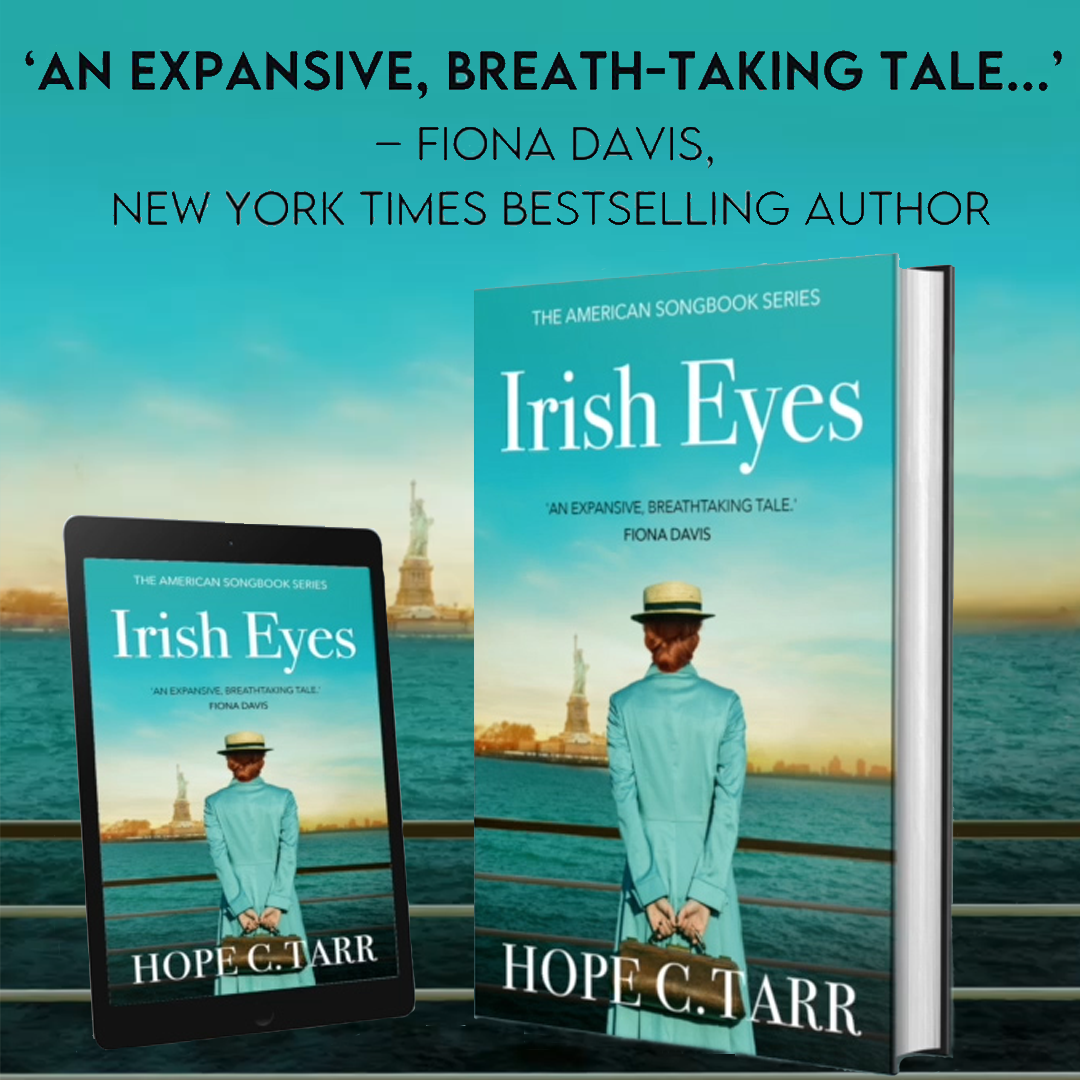
A Q&A with Hope C. Tarr, Author of Irish Eyes (2023)

Welcome back to the Secret Victorianst for a different sort of blog today—an interview with fellow historical novelist, Hope C. Tarr. You might remember Hope from the virtual panel event I did with Lady Jane’s Salon, the NYC-based romance readers’ club she co-founded, back in 2020. Next month, Hope’s debut historical novel Irish Eyes will be released by Lume Books, and I know readers of the Secret Victorianist are going to love it. Irish Eyes opens on the Aran Islands in 1898 and takes readers on a journey, with its heroine Rose, to the streets of late nineteenth/early twentieth-century New York City. I hope you enjoy my conversation with Hope and enter for a chance to win a copy of her novel below!

SV: How did you first get the idea for your novel, Irish Eyes?

Hope: Irish Eyes is very much a love note to my Irish ancestors, who came to America on the coffin ships at the height of the Great Hunger. For years, I batted around the idea of writing something with an Irish heroine. Finally, on a hiking trip to Western Ireland in (gulp) 2008, I stopped at the famed Cliffs of Moher and gazed across Galway Bay to the trio of islands known as the Arans, and Rose O'Neill’s story began taking shape in my mind. Back in Manhattan, running along the Hudson River, looking out to Ellis Island and Lady Liberty helped further flesh out Rose’s story.

SV: How did the book evolve from your first to your final draft?

Hope: Whoever first said that “writing is in the rewriting” was wise indeed. Irish Eyes changed so many times. Originally, I had a prologue, in fact two prologues, which I really loved. The first prologue began with Rose in 1922 at mass narrating her life story to the parish priest. The second prologue started with Adam, Rose's future love interest, at the Battle of San Juan Heights during the Spanish-American War. I've actually shared that prologue on my History With Hope Substack! To pick up the pacing and start in the thick of the story, both of these very different prologues ended up on the chopping block. A la Stephen King, sometimes you really do have to murder your darlings. 😉

But by far the biggest shift in molding the story was also the scariest. At the onset, I'd written the entire book in my trusty go-to perspective: third-person. But something was missing. The story wasn't... gelling. As a reader, I'd always adored novels written in the first-person—du Maurier’s Rebecca, anyone? —but I'd never had the courage to try first-person POV myself. Once I did and rewrote the entire book in Rose's voice, it all began coming together.

SV: How did writing historical fiction differ from the genres you've written in in the past?

Hope: After wonderful years spent writing 20+ romances for Penguin, Harlequin, and Macmillan, I was ready for a BIG change. Ready to push the boundaries of genre and do a deep dive into history, in this case, mostly early twentieth-century history. Ready to write the sort of big, sweeping historical novel that I'd grown up devouring. Books like Diana Gabaldon's Outlander series, technically romance, where you get to spend time with the characters, who evolve over not days/weeks/months but years. In other words, a saga. For a while now, “saga” has been something of a dirty word in American publishing. For that reason, I suspected I was going to have a tough time selling this book, especially as it would be my historical fiction debut, which probably explains why it took me so long to finish it and then shape it into a shoppable manuscript. That being said, if I had to sum up the experience of writing Irish Eyes and bringing it to this point, that word would be “freeing.”

SV: Do you have any tips for writers of historical fiction who are trying to make their books relatable to modern readers without being anachronistic?

Hope: Admittedly, this can be a tough balance to strike, especially when keeping in mind younger readers, who approach fiction with a very different set of expectations than I did at that age. With Irish Eyes, as with any historical fiction, I try to step back and ask myself, “how critical is this point/word/phrase to telling a great story?” If the answer is “not so much,” I may leave it out rather than veer into anachronism. But I also think it's important to understand how we've collectively evolved over the eras. And not evolved. So many of the issues addressed in Irish Eyes—immigration, the roles and rights of women, labor reform, income inequality—are eerily reflective of our present moment. History is cyclical, not linear. It's important to bear in mind that we are making "history" every waking moment.

SV: Your novel, while it's one woman's story, touches on major world and local events, e.g., WWI and the Triangle Shirtwaist Factory fire. What was your process like for naturally weaving these references into the novel?

Hope: The biggest challenge in writing Irish Eyes was to decide what historical events not to include. (Back to murdering those darlings!). The book covers 24 years in Rose's life. While the 24/7 news cycle is a recent phenomenon, newspapers were a big, busy feature of turn-of-the-century life. In writing the novel, I put in, and later took out, several events that, while interesting, wouldn't have directly impacted the immigrant community of my fictional heroine and her growing family. For example, the assassination of President McKinley (September 14, 1901) gets a brief mention while the Triangle Shirtwaist Factory Fire of March 25, 1911, in Lower Manhattan, gets a half-chapter.

SV: You're a New Yorker yourself. How did this help your process in writing the book?

Hope: Living here as I've been privileged to do, the city's history is all around, waiting to reveal its stories to those open to knowing them. I was here in 2011 for the centennial commemoration of the Triangle Shirtwaist Factory Fire at the Brown Building (formerly the Asch Building) where the factory was housed in 1911. The long-anticipated memorial was dedicated in October 2023. The adjacent Washington Square Park began as a potter's field when a series of yellow fever outbreaks starting in 1797 caused the city morgues to overflow. Human remains still rest beneath the elegant fountain and curated plantings. McSorley's Old Alehouse, NYC's oldest continuously operating bar (1854-present), which I recently revisited for another History With Hope episode, serves the same cheddar cheese and onion platters it did back when the great illusionist Houdini stopped in for a post-performance pint.

SV: What historical novels have you read and loved recently?

Hope: I'm very keen on World War II at the moment, likely because I'm working on the sequel to Irish Eyes, set in occupied Paris. I recently finished, and loved, Good Night From Paris, by Jane Healey, a fictional account of the real-life Hollywood screen actress, Drue Leyton, who was living in Paris with her French husband when the Second World War broke out. Rather than return home to the States, Drue accepted a position broadcasting from Paris to the (then neutral) US. Under the Nazi occupation, she repeatedly risked her life working for the Resistance.

SV: What should we look forward to seeing later in the American Songbook Series?

Hope: As I cagily slipped in above, I'm at work on a sequel, Stardust! The second book in my American Songbook series, Stardust follows Rose's granddaughter, Daisy, into the late 1930s and 1940s. Fashioned in the image of her indomitable Irish grandmother, Daisy will take the reins of Rose's Kavanaugh's Department Store when the time comes. In preparation, Rose sends Daisy to Paris to apprentice with the iconic couturier and fragrance entrepreneur, Coco Chanel. In shadowing the mercurial Chanel, Daisy is thrown into the thick of a glittering and treacherous cast of characters—American and British expats, the Parisian haute-monde, war correspondents, and German spies—all of whom congregate at the Hotel Ritz. While she's there, the Nazis invade and occupy Paris. Like the world-famous Chanel No. 5, a blend of 80 secret ingredients, no one in occupied Paris is what they at first seem. 😉

Hope C. Tarr

SV: Thank you so much for speaking with me, Hope, and for giving me the chance to read Irish Eyes ahead of publication. 

Hope: Thank you so much for having me! I hope readers will enjoy Irish Eyes as much as I loved writing it.

Would you like to win a signed paperback copy of Hope C. Tarr’s Irish Eyes, alongside a signed paperback of my own historical novel, Bronte’s Mistress? If so, sign up to my monthly email newsletter here. Anyone who subscribes to the newsletter between 21st November 2023 and 7th December 2023 (the Irish Eyes release day!) will be entered into a random draw to win both books. Already signed up? Spread the word to friends and family who might want to win and stay in touch with me via Facebook, Instagram, and Twitter.

Thursday, 16 June 2022

A Nineteenth-Century Ballet Reimagined: Akram Khan’s Giselle, Brooklyn Academy of Music

I’ve written about ballet through a Victorianist’s lens quite a few times over the course of the last nine years on this blog, but, thanks partly to the pandemic, it’s been a while since I was able to review a live performance. I blogged about Coppelia and Anna Karenina in 2018, Le Corsair and The (ever-popular) Nutcracker in 2016, and Jane Eyre back in 2013. This time I’m back to talk about one of the greatest nineteenth-century ballets—Giselle—having just seen a very different production.

Giselle, with music by Adolphe Adam and a story by librettists Theophile Gautier and Jules-Henri Vernoy de Saint-Georges, was first performed in 1841 in Paris, starring ballerina Carlotta Grisi in the title role. The ballet is in two acts—the first tells the story of the peasant girl Giselle’s betrayal by her lover, Albrecht (a nobleman in disguise), and her subsequent death; the second reanimates Giselle as she joins a host of wilis (spirits seeking revenge against the men who wronged them). 

I’ve seen traditional Giselles several times (most recently, the ABT’s production was my first live theater experience post-Covid lockdowns in October 2021). But last week I was lucky enough to watch Akram Khan’s innovative version by the English National Ballet. This production premiered in the UK in 2016, but the short run at BAM (the Brooklyn Academy of Music) marked its first performance in New York City. I saw the Saturday matinee, with Erina Takahashi as the lead. 

Gone is the pastoral setting of the traditional first act, with Giselle and her peasant girl friends skipping outside cottages and responding to the hunter’s bugle call. The production instead invites us into a stark and industrial setting. The nobles here are the “landlords” and the peasants “outcasts” who work in the condemned factory. Dressed in gray rags, Giselle and her community flit around stage, their movements often synchronized, to percussive music from Vincenzo Lamagna.

Ballet fans will recognize strains of the original score coming in and the basics of the storyline remain the same, but the contrast between two acts is dampened—this is a Giselle that’s dark throughout. I enjoyed this tonal shift from the original: Act II of the ballet is often considered stronger and was often performed alone even in the 1800s. But audiences may find themselves asking if Giselle’s death is so terrible given the miserable, dystopian existence she experienced before. 

I was pleased however that the bleakness is heightened by genuine spookiness in Act II, thanks in part to a wonderful performance by Isabelle Brouwers as Myrtha, the queen of the wilis. The production uses pointe work (largely absent from Act I) to convey the ghosts’ ethereal movements to great effect. So far, so traditional, but these spirits also brandish large sticks as weapons, bringing martial arts style choreography to the all-female corps de ballet on their tiptoes. This sticks are also used to act as physical barriers between the living and the dead, leading to an ending I found genuinely emotional, as Giselle forgives Albrecht and returns, divided from him, to her grave.

There are plenty of clips of the production online, but, if you can, do try to see this ballet live—it’s a theatrical experience I’ll be thinking about for a long time.

Do you know of any upcoming NYC shows you’d love the Secret Victorianist to review? Let me know—here, on Facebook, via Instagram, or by tweeting @SVictorianist.

Sunday, 7 June 2020

(More!) Novels of the French Revolution

Back in October, to celebrate the release of Ribbons of Scarlet (2019)—a multi-authored historical novel about the women of the French Revolution—I strayed out of the nineteenth century and into the late eighteenth, with a round up of the best novels I’d read set during that tumultuous period.


I reviewed Andrew Miller’s Pure (2011), Hilary Mantel’s A Place of Greater Safety (1992), Daphne du Maurier’s The Glassblowers (1963), and the most iconic of all novels of the French Revolution, Charles Dickens’s A Tale of Two Cities (1859).


Eight months later, I’m back, with thoughts on three more novels, which take this bloody conflict as their backdrop.


Three more "revolutionary" reads

Mistress of the Revolution, Catherine Delors (2008)

Delors’s novel centres on noblewoman Gabrielle—first, on the trials and tribulations of her childhood, doomed adolescent love and horrific forced marriage, and, later, on how she becomes embroiled in the events of the revolution. Gabrielle’s lot is a believable, if dramatic, one, but her character is underdeveloped and she seems to offer little beyond her attractiveness (her main bargaining chip throughout the book). There’s plenty of sexual content to titillate and horrify by turns, and Delors covers a lot of ground historically, incorporating some great details. Yet, on occasion, passages of political exposition become a little skim-worthy.


Becoming Josephine, Heather Webb (2013)

Webb’s protagonist’s biography would strain our credulity were it not true! This novel takes the future Empress Josephine as its subject, from her childhood in Martinique, to her terrible first marriage (there’s a theme here), to her love with Napoleon, to the pressures mounted on her to produce an heir, and beyond. Josephine was placed to be a great observer of the revolution, so these sections in particular are well wrought, and the nuances of her relationship with Napoleon come through. However the later parts of her life are a little rushed. I wish Webb had ended sooner, so the book had a clear novelistic arc vs. bordering on dramatized biography.


Little, Edward Carey (2018)

Carey’s Little (my most recent revolutionary read) is a very different beast. Like Webb, he takes a real person, who had a front row seat at the revolution, as his main character. In this case, it’s Marie Grosholtz, still famous the world over as Madame Tussaud. However, Carey isn’t constrained by history. His novel reads as an imaginative response to the art of waxworks, against the backdrop of a violent period when real bodies were frequently dismembered. His Marie (referred to by other characters as “Little” due to her diminutive size) is obsessed with bodies—their innards and their outer flaws and features. Illustrated by the author, this isn’t a read for the faint-hearted or weak-stomached, but it captures the madness and horror of the French Revolution, as well as the obsession with objects (clothes, wigs, locks, wax figures), which gave so many eighteenth-century Parisians their livelihood.


Do you know of any more great books set during the French Revolution? Let me know—here, on Facebook, on Instagram, or by tweeting @SVictorianist.


My first novel, Bronte’s Mistress, about the older woman who had an affair with Branwell Bronte, is available for pre-order now. Subscribe to my newsletter for monthly updates below.


Get updates on my novel - Bronte's Mistress

* indicates required


Friday, 4 October 2019

Novels of the French Revolution


Back in June, the Secret Victorianist attended the Historical Novel Society Conference in Maryland (read my full review of the event here). While there, I was lucky enough to receive a signed advanced reader copy of Ribbons of Scarlet (2019), a novel jointly written by six historical novelists depicting the lives of many of the women who played an important role in the French Revolution, which began in 1789.

Ribbons of Scarlet is now top of my TBR (to be read) list, but in honour of the novel’s release on October 1, in this week’s blog post, I’m straying out of the nineteenth century and back into the eighteenth to share with you some of my favourite reads set during, or inspired by, the revolution that rocked Europe and changed France forever.


A Tale of Two Cities, Charles Dickens (1859)

Dickens’s depiction of the revolution, written seventy years later, influences how its events live on in popular imagination to this day. Expect narrow escapes from the guillotine, long imprisonments and rampant blood lust.

Aside from being a classic, A Tale of Two Cities offers a great glimpse into British responses to the revolution on England’s doorstep. It also has one of the best openings of any novel in English (check out my close reading here). Bonus fun fact: I once appeared as Monsieur (yes, Monsieur, not Madame) Defarge in a school play.


The Glass Blowers, Daphne du Maurier (1963)

Daphne du Maurier dug into her own family history to inspire her 1963 The Glass Blowers, a wonderful novel that examines the revolution through the eyes of a middle class family in the provinces. The novel deals with the divisions within families occasioned by any civil war and the misinformation that fuelled much of the paranoia that dominated the French Revolution.

Her main character, an unobtrusive first person, is representative of many men and especially women of the period, who tried to maintain domestic normality, while war and political strife ravaged the country.


A Place of Greater Safety, Hilary Mantel (1992)

Reading Hilary Mantel’s dense and captivating novel is as close as we can come today to experiencing the French Revolution blow by blow. Focused on Paris, Mantel illuminates the lives of three of the conflict’s main actors—Georges Danton, Camille Desmoulins, and Maximilien Robespierre—with a huge cast of supporting characters.

The novel is replete with interpersonal as well as political drama but this isn’t a story of ordinary people. If you want to dig into the nitty-gritty of factions, espionage and corruption, this is the book for you.


Pure, Andrew Miller (2011)

The most recent novel on my list, Pure isn’t really a novel of the Revolution at all, but of the years preceding it. Our protagonist is an engineer tasked with clearing the graveyard at Les Innocents in Paris, which is literally overflowing with corpses and therefore endangering the health of the city's residents.

The book captures the rising tensions in Paris in the 1780s, the bureaucracy of Versailles, the autonomy of different parts of the city and the fading influence of the Catholic Church. There’s even a cameo for Dr Guillotine himself as social discord rumbles, creating a dramatic stage for our central story. It’s dark, compelling, and beautifully told.


Other French Revolution related novels that are on my radar include Catherine Delors’s Mistress of the Revolution (2008), Edward Carey’s Little (2018), and, of course, Ribbons of Scarlet. But I’d love to hear what other books on the topic you’d recommend I check out! Let me know—here, on Facebook or by tweeting @SVictorianist.

Saturday, 15 June 2019

Review: The Bronte Project, Jennifer Vandever (2006)


Most of the novels I review for this blog are set during the nineteenth century—Jennifer’s Vandever’s 2006 The Bronte Project is not.


Her protagonist, Sara Frost, is a struggling academic in twenty-first-century New York City, who’s on a quest to discover lost letters to shine more light on Charlotte Bronte’s unrequited passion for her Belgian schoolteacher. But Charlotte’s love life isn’t the only one on the rocks. At 28, Sara is left reeling when her fiancé abandons her to live down and out in Paris, imitating his hero, George Orwell. ‘Moving on’ is hard when you’re still safeguarding an ex’s beloved first editions and when the other men in your orbit are an alcoholic Hollywood producer who wants you to sex up the Brontes and a Frenchman with a penchant for breaking into your apartment and calling people poems who might or might not be sleeping with his half-sister.

The Bronte Project, as you may be gathering, is pretty silly stuff, but what’s fun about it is how the novel defies expectations about the trajectory of women’s fiction. Without giving away the ending, neither Sara’s romantic journey nor her work on the Bronte siblings concludes as I imagined in the opening pages, which felt like the first twenty minutes of a predictable rom com. As long as you don’t go into this expecting a heart-warming romance, you’re sure to be entertained.

Jennifer Vandever (1968- )
Vandever is strongest as a satirist, turning a critical eye on New York vs. LA culture and the trappings of modern academia. One of her best-realised characters is Claire Vigee, a rising star at the university who’s pioneering the field of ‘Diana Studies’, centred on the life of the late princess. In fact Princess Diana, at times, seems to take over the novel as its central reference point, rather than the Brontes. For a Victorianist, it’s disappointing that, aside from the inclusion of quotes from Charlotte at the opening of each chapter and a few extended passages to educate readers on the siblings’ lives, the engagement with Bronte trivia is pretty superficial.

Overall, The Bronte Project is a light and funny read, with original quirks and good prose. If you want to bring the Brontes with you to the beach this summer, it could be worth picking up.

Do you know of any other contemporary novels with a nineteenth century twist you think the Secret Victorianist should read next? Let me know—here, on Facebook or by tweeting @SVictorianist.

Wednesday, 10 April 2019

Art Review: Boilly: Scenes of Parisian Life, The National Gallery, London


Recently the Secret Victorianist found herself back in London and on the hunt for nineteenth-century culture in the British capital.


‘A Carnival Scene’ (1832)
The National Gallery’s ‘Scenes of Parisian Life’ exhibition is the first dedicated to lesser-known French painter Louis-Léopold Boilly (1761-1845) in the UK. It features around twenty paintings but what the exhibition lacks in scale it more than makes up for in variety, demonstrating the range of Boilly’s subjects and media.

Looked down on as ‘just’ a genre painter in his day without the support of the establishment given lauded neoclassical history painters like Jacques-Louis David (1748-1825), Boilly’s output was dictated by public taste and market forces.


'Comparing Little Feet' (1791)

After arriving in Paris in 1785, he did a brisk trade in scenes featuring young woman in elegant interiors, often with a risqué edge. One of these, ‘Comparing Little Feet’ (1791) was on display at the National Gallery. In it, two women strip off their stockings, ostensibly to compare their shoe sizes.

However, in the tumultuous time of the Revolution, Boilly found himself in hot water for his brand of titillating art. He survived with his head but pivoted—to more patriotic subjects, visual illusions and the Parisian crowdscapes for which he is most remembered.


'The Meeting of Artists in Isabey’s Studio’ (1799)
His ‘The Meeting of Artists in Isabey’s Studio’ (1799) (also on view) is a ‘who’s who’ of the Parisian art world at the advent of the nineteenth century, including 31 painters, sculptors and architects and, of course, Boilly himself. Notably, not a single woman is invited to this idealised meeting of the minds, despite the Revolution being an unprecedented period of freedom for women artists.

Crowd scenes featured in the exhibition include ‘The Barrel Game’ (1828), ‘The Poor Cat’ (1832) and ‘A Carnival Scene’ (1832). All depict the colourful menagerie of nineteenth-century urban life, with city-dwellers of every class side by side. Hidden in the paintings are dramatic incidents that provoke a smile—a child grasps at an apple, a man urinates against a wall, a boy picks a pocket, a dog runs off with a carnival mask.


'The Poor Cat’ (1832) 

Boilly’s humour is distinctive, even if his expression in his self-portraits is usually stern. He coined the term ‘trompe-l’oeil’ (a trick of the eye) for works in which uses one medium to imitate another. His painting of crucifix appears 3D, while his signature seems to be pinned beside it, a slightly blasphemous advertisement.


'A Trompe-l'oeil: Crucifix of Ivory and Wood' (1812)
Observing Boilly’s Paris is like reading Dickens’s London. Never has the nineteenth century looked so alive. 

Boilly:Scenes of Parisian Life’ is free and open to the public at The National Gallery until 19th May 2019. Visit if you can.

Do you know of any New York-based nineteenth-century-focused exhibitions you’d like the Secret Victorianist to review next? Let me know—here, on Facebook or by tweeting @SVictorianist.