Showing posts with label Emma Donoghue. Show all posts

Saturday, 4 January 2025

2024: My Year in Reading—A Retrospect

Happy New Year! After tracking my progress via Goodreads, today, for the fifth year in a row, I’m sharing a retrospect on the books I read in the last year. (Here are the links to check out the 2023, 2022, 2021, and 2020 editions if you’d like to travel back in time!)

In 2024, as in 2023, I read 50 books, an average pace of approximately 50 pages a day. 

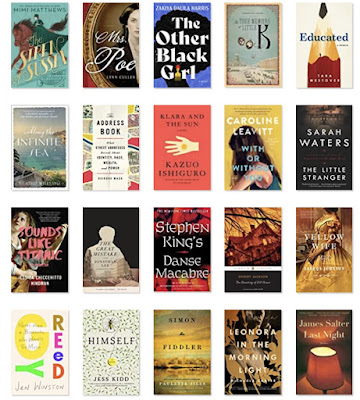
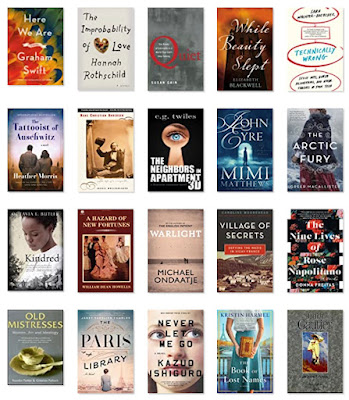
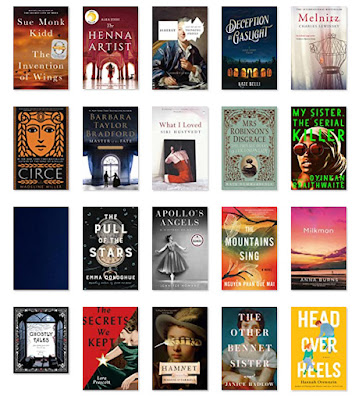
My preference for fiction over non-fiction remains clear, with 41 vs. 9 books read. But my non-fiction reading covered topics of particular interest to me, such as art (All the Beauty in the World, Patrick Bringley, and The Art Thief, Michael Finkel), ballet (Turning Pointe, Chloe Angyal), and the nineteenth century (Stranger in the Shogun’s City, Amy Stanley, reviewed here, and The Talented Mrs. Mandelbaum, Margalit Fox), and expanded into less expected areas (e.g., memoirs by Flea, Esmeralda Santiago, and Patricia E. Beattie, and the story of an eighteenth-century naval mutiny, in David Grann’s The Wager).

When it comes to fiction, for the first time in one of these reviews, one contemporary author dominates—I read six (!) novels by Tana French in 2024 and continue to love her work. 

I reviewed three novels as part of my Neo-Victorian Voices series, covering books set in the nineteenth century, but written in the twenty-first: Edward Carey’s Edith Holler, Ami McKay’s The Witches of New York, and Emma Donoghue’s Frog Music. And I also read and blogged about two pieces of nineteenth-century French fiction in translation: Three Tales, Gustave Flaubert, and The Animal, Rachilde. 

My interest in my own genre, historical fiction, remains strong, accounting for 20% of books I read last year. Other strong themes for the year in fiction included witches (The Scandalous Confessions of Lydia Bennet, Witch, Melinda Taub, The Manningtree Witches, A.K. Blakemore, The Witches of New York, Ami McKay, and Weyward, Emilia Hart), ballet (Tiny Pretty Things, Dhonielle Clayton and Sona Charaipotra, and The Dance of the Dolls, Lucy Ashe), and, as ever, books by friends/acquaintances (Marvelous, Molly Greeley, The Last Star Standing, C.G. Twiles, and What's Eating Jackie Oh?, Patricia Park). 

Thirty-five books I read this year were by women, and 15 by men, which is slightly more gender-balanced than in 2023. 

In 2025, I’ll again be aiming to read 50 books. My reading resolutions? Continue to embrace the unexpected (one of my favorite 2024 reads was Chelsea G. Summers’s A Certain Hunger, a book about a female cannibal!), prioritize joy in reading, and continue to support writer friends. 

What books did you enjoy reading in 2024 that I should continue adding to my list? Let me know—here, on Facebook, on Instagram, or by tweeting @SVictorianist. Want to stay in touch? Sign up to my monthly email newsletter here.

Wednesday, 21 August 2024

Neo-Victorian Voices: Frog Music, Emma Donoghue (2014)

I’m back with a review of yet another novel written in the twenty-first century, but set in the nineteenth, as part of my Neo-Victorian Voices blog series. This time we’re in 1876 San Francisco for Frog Music by Emma Donoghue, whose 2016 novel, The Wonder, I reviewed back in 2018.

Frog Music really drives home the idea that truth can be stranger than fiction when it comes to writing historical novels. I had no idea how well-researched the book was and how deeply Donoghue had engaged with the historical record until I read her concluding author’s note. 

Not only is it true that SF was suffering a sweltering summer, along with a smallpox epidemic, in 1876, but the murder the book opens with was a real crime. Jenny Bonnet was a cross-dressing, unicycle-pedaling frog catcher, who had frequent run-ins with the city police. But the question is: who shot her dead?

In Donoghue’s novel, Blanche Beunon, the dancer and sex worker who was with Bonnet when she died, is the character who sets out to uncover the truth. But Blanche has problems of her own to deal with—an angry erstwhile lover, disagreements with the madam at her brothel, and (most heart wrenchingly) trying to locate her missing baby. We alternate between sections focused on Blanche’s investigations and earlier scenes depicting the meeting and relationship between Blanche and Jenny, as Donoghue skillfully unravels what happened and, crucially, why.

If you’re a fan of trigger warnings for fiction, please note that this novel would require many. Donoghue’s brand of historical fiction is gritty, peopled by characters who are of their time when it comes to their illnesses, hygiene, and more. Frog Music details child neglect and animal cruelty, and the novel also contains sex scenes that walk the line between consensual and non-consensual.

But that isn’t to say that the novel is entirely dark. Music, as you might imagine from the title, is a powerful through line in the book and the snippets of nineteenth-century lyrics that pepper Jenny and Blanche’s interactions paint a vibrant picture of 1870s West Coast culture. My favorite thing was how transported I felt to nineteenth-century San Francisco, where different immigrant groups were meeting and forming a new, composite culture.

Overall, I’d recommend Frog Music to readers who a) won’t get queasy at realistic depictions of nineteenth-century life, b) have an interest in queer relationships in the period, and c) love SF. 

Let me know what novel you’d like to see me review next as part of the Neo-Victorian Voices series. You can always contact me on Instagram, Facebook, or Twitter. And don’t forget to sign up to my monthly email newsletter.


Thursday, 20 April 2023

Film Review: The Wonder (2022)

Back in 2018, I reviewed Emma Donoghue’s 2016 nineteenth-century-Ireland-set novel, The Wonder, for this blog—check out my full review here. Today, five years on, I’m back with a post about the book’s film adaptation.

The Wonder (2022) is remarkably true to Donoghue’s novel and doesn’t resort to Hollywood theatrics to enhance the story. It stars Florence Pugh as the English nurse, Lib, and she’s the ideal actor to pull off the role. Despite the slight plot and limited setting, Pugh’s facial expressions alone are enough to keep our interest for nearly two hours. The filmmakers also do a great job conveying the moody atmosphere, which makes the genre of the movie initially difficult to pin down. Are we in a horror film or is this psychological horror? movie watchers might ask themselves in the first thirty minutes.

One result of the faithful adaptation is that my original criticisms of the novel still hold. The romantic subplot is underdeveloped, and Lib never sways in her rational beliefs, although I would have loved to see Pugh grappling with whether to accept a supernatural explanation for her patient’s lack of appetite. The movie also introduces a new problem—a slightly bizarre and meta frame story, that reminds us that we are watching actors, not real people. This was a strange choice, but these short opening and closing minutes do little to detract from what is an entertaining watch.

Overall, I’d recommend The Wonder to fans of costume dramas and Pugh, and anyone with an interest in nineteenth-century Ireland. I loved how the film emphasized the trauma of the Great Famine, placing a disturbing story about one child who refuses to eat in a wider cultural and historical context. Writers may also wish to compare the novel to the screenplay to understand how small changes can play to different media.

What nineteenth-century film would you like the Secret Victorianist to review next? Let me know—here, on Facebook, on Instagram, or by tweeting @SVictorianist. 

Friday, 14 January 2022

2021: My Year in Reading—A Retrospect

Around this time a year ago, I published a retrospect on my 2020 reading. Now I’m back, a year on, with a similar post, looking back on the 60 books (10 more than the year before!) I read in 2021. 

In 2021, I read 45 novels and 15 works of non-fiction. I favored books by women writers, reading 49 books penned by women, 10 by men, and one mixed anthology. Ten of the books I read were by writers of color. And, unsurprisingly for a writer of historical fiction, “hist fic” remained my favorite genre, making up nearly half (26 books) of what I read this year.

Favorites

Just like last year, I’m chickening out and not crowning a favorite read of the year, but in no particular (okay alphabetical) order, here are my top five fiction recommendations:

Milkman, Anna Burns (2018)

An original, lyrical, Booker Prize-winning novel set in Northern Ireland (where I grew up)? Of course, I was going to love this book! Be warned: Milkman isn’t an easy read, but it’s a rewarding one.

The Pull of the Stars, Emma Donoghue (2020)

We’re living through one pandemic, so do we really want to read about another? The answer is yes, but only if that book is Emma Donoghue’s story of the Spanish Flu, set in Dublin in 1918. A gritty insight into a nurse battling on a maternity ward as Europe is ravaged by war and disease, coupled with a queer love story, this novel is a winner for historical fiction fans. 

Never Let Me Go, Kazuo Ishiguro (2005)

I also read Ishiguro’s newest release, Klara and the Sun (2021), this year. I enjoyed it too, but his 2005 novel of an English boarding school that isn’t quite what it seems wins my vote.

Hamnet, Maggie O’Farrell (2020)

Everyone was raving about this novel about Shakespeare’s wife in 2020. I didn’t get to it until 2021, but believe the hype—this is one beautiful book!

The Little Stranger, Sarah Waters (2009)

I love a Gothic ghost story with a stylish historical background and a great twist. Above all, Sarah Waters is a great storyteller—expect to fly through this one. 

Feeling Arty?

One theme I noticed in my reading in 2021, was that I was very drawn to books that deal with other art forms beyond the literary. Here are some recommendations if you’re into…

Visual Arts:

Novels—Leonora in the Morning Light, Michaela Carter (2021); What I Loved, Siri Hustvedt (2002); The Improbability of Love, Hannah Rothschild (2015)

Non-Fiction—Old Mistresses, Rozsika Parker & Griselda Pollock (1982)

Dance:

Novel—The True Memoirs of Little K, Adrienne Sharp (2010)

Non-Fiction—Apollo’s Angels, Jennifer Homans (2010)

Music:

Novels— Simon the Fiddler, Paulette Jiles (2020) (review here); Along the Infinite Sea, Beatriz Williams (2015)

Memoir—Sounds Like Titanic, Jessica Chiccehitto Hindman (2020)

Or Want to Feel Scared?

Another theme was books that deal with the strange, the spooky, and the downright frightening. In addition to The Little Stranger, which I wrote about above, I also read Shirley Jackson’s classic The Haunting of Hill House (1959), Mimi Matthews's gender-swapped retelling of Charlotte Bronte's Jane Eyre with a vampiric twist, John Eyre (2021) (review here), and Ghostly Tales: Spine-Chilling Stories of the Victorian Age (2017), an anthology of nineteenth-century ghost stories. 

For a survey of the horror genre, also check out Stephen King’s non-fiction book, Danse Macabre (1981). As someone who loves both The Sound of Music and horror movies, I couldn’t get behind everything King writes here, but his overview is well worth reading.

Discover Fascinating Lives

Finally, the biographies I read in 2021 are reflective of my interest in lesser spoken about historical figures, who I think led lives worth remembering. 

Join me by taking an interest in…

Denis Diderot, French philosopher, art critic and writer (1713-1784): I read Diderot and the Art of Thinking Freely, Andrew S. Curran (2019).

Danish father of fairytales, Hans Christian Andersen (1805-1875): I read Hans Christian Andersen: The Life of a Storyteller, Jackie Wullschlager (2001).

French poet Theophile Gautier (1811-1872): I read Joanna Richardson’s 1959 biography, Theophile Gautier—Hist Life and Times.

His daughter, Judith Gautier (1845-1917), a poet, writer, and lover of Chinese culture: I read Joanna Richardson’s 1987 biography, Judith Gautier.

I’ll be back at the end of this year or the start of next with a summary of what I read in 2022. In the meantime, let me know if you have any reading recommendations for me. I’d love to know what books are on your nightstand. If you’re looking for a book to read, check out my debut novel, Bronte’s Mistress (2020). And, remember, you can always contact me, here, on Facebook, on Instagram, or by tweeting @SVictorianist. Happy reading! 

Sunday, 26 August 2018

Neo-Victorian Voices: The Wonder, Emma Donoghue (2016)

Many will know Irish-Canadian novelist Emma Donoghue from her much-lauded Room (2010)—the contemporary tale of a woman trapped by a predator and bringing up her son in captivity. But Donoghue’s works when viewed as an oeuvre otherwise have a decidedly historical bent. There’s Slammerkin (2000), inspired by an eighteenth-century murder, The Sealed Letter (2008), the story of an 1864 divorce case and Frog Music (2014), the tale of a nineteenth-century cross-dressing frog catcher. And then there’s her 2016 The Wonder, which I’m writing about today—a novel set in the 1850s that pits the English rationality of a nurse trained under Florence Nightingale against a village of superstitious Irish peasants, convinced they have a miracle in their midst.

The Wonder (2016)

Eleven-year-old Anna O’Donnell hasn’t eaten in months, or so her parents claim. Is God sustaining the child with manna? Or is this a hoax, a medical oddity, something more sinister? Lib Wright, our protagonist, is determined to be vigilant and to get to the bottom of the mystery, but she doesn’t expect to grow fond of her devout and unworldly patient, or that she will have to confront her past—the secrets she is hiding of her own.

Donoghue’s cast of characters is small and her setting a tiny village, with one store-cum-drinking place, surrounded by bog. I was unsure how the simple premise would play out over the length of a novel but she’s masterful at building tension and at suggesting the monotony and repetitions of a nurse’s ‘watch’ or ‘vigil’, while keeping readers turning the pages.

Emma Donoghue (1969-)

The Ireland of the mid-nineteenth century leaps off the page, but, most unsettling, it’s not unthinkable to imagine a similar story unfolding in the country’s rural communities today. There’s much that’s recognisable—the pervasiveness of religion, which mingles with folklore and myth, the hostility towards outsiders, the culture of secrecy, suffering and martyrdom.

Much as I enjoyed the novel, there were two slight disappointments. First, the love interest character—a journalist—is under-developed, convenient for plotting purposes but lacking the nuance of Lib, Anna and others. Second, nothing really forces Lib to reassess her prejudices about the zealots she’s surrounded by. It wasn’t that I was hoping for a supernatural explanation but I would have liked a moment of self-revelation, where Lib rethought some of her assumptions.

Overall The Wonder is a quiet sort of historical novel, with drama and action saved for the final pages. It’s a novel about caregivers and patients, cynics and believers, and, more than anything, our complex relationship with food, our bodies, appetite. Donoghue has a gift for uncovering tales from the past, which have resonance today.

Which twenty-first century novel, set in the nineteenth, would you like the Secret Victorianist to review next as part of my Neo-Victorian Voices series? Let me know—here, on Facebook or by tweeting @SVictorianist.